Traditionally, academic staff interact synchronously. That's a fancy way to say that they have meetings. But what if you miss a meeting, or if the time allocation in the meeting is insufficient to thoroughly debate a point - or even to complete an agenda? What if the agenda item is overshadowed by unforeseen developments?
At Ultralab we obviously have meetings! But we also use a range of asynchronous and synchronosue tools to develop our work and our sense of community, both for those staff employed at Chelmsford and for remote colleagues.
In developing the
learning communities for NCSL, our facilitators and tutors were appointed
on home based contracts. Stretching from Derry to Fife to Land's End the
traditional meeting was clearly not cost effective. In order to develop
a common purpose and team working, asynchronous conferencing was used
extensively from day one. Through the use of online forums and conferences
a surrogate, virtual, working place was developed.
As this virtual team
bonded into a community of practice, so other technologies and techniques
were needed. Termly face-to-face weeks were scheduled, regular telephone
conferences held, instant messenger services exploited. So, onto the backbone
of the ongoing asynchronous channels, synchronous tools provided a means
to deepen participation in the community, to generate a sense of belonging,
and shared endeavour in course development, continuing professional education,
peer review and reflection.
This model has been refined for use by the tutor/facilitator team on Ultraversity's BA in Learning, Technology and Research and extended to the student-researchers enrolled on it.
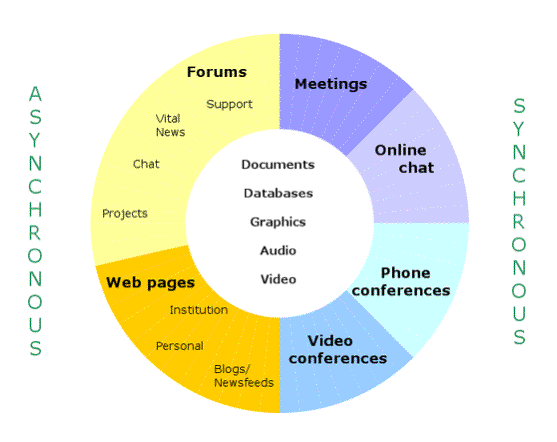
ASYNCHRONOUS AND SYNCHRONOUS
not
ASYNCHRONOUS OR SYNCHRONOUS