Section
3
Lessons
for online teachers
3.1
Methods
The
methods used to collect the data for section 3 were as follows:
- Contributions
to the online discussion space in all Virtual Heads and Bursars communities
- Interpretative
analysis of NPQH hotseats
- Interpretative
analysis of a selection of online discussions
- Face
to face meetings with NPQH and Bursars online teachers
- Informal
interviews with teachers and learners
- A
semi-structured telephone survey of NPQH learners carried out in July 2001
- Case
studies undertaken with learners and teachers in May - June 2002
This
is consistent with the research methodology outlined in section 1.
3.2
Participation and Engagement
As
outlined in section 1 the key to success in any learning activity is the engagement
of the learners in the community and their active participation in the dialogue.
In a face-to-face context, this can be seen in attendance at seminars and
tutorials and in the submission of material for assessment at the end of each
unit or module. Online, the learner has to be visible if participation is
to be confirmed and this may lead to tensions between the self directed learner
for whom the online environment does not fit their preferred learning style
and the need for the online teacher to ensure the learner is present. The
online teacher, therefore, needs to design activities and tasks that encourage
contribution and response. Evidence shows that in social communities, without
the imperative of assessment and qualifications, participation rates are around
6-10% (Wenger, 1998). This low rate is clearly inadequate to sustain a model
of social and constructivist learning, which requires not only engagement
but also active participation. ULTRALAB have found that if the philosophy
of the programme continually reflects participation and collaboration (see
section 1) then it is more likely to engender increased participation. Key
to maximising this participation is the role played by the online teachers.
This
section 3 outlines the findings for online teachers, which documents the successful
processes online teachers are engaged in to enhance learning. Section 4 outlines
the evidence of learning for online learners from the NPQH programme.
3.3
Findings for Online Teachers
The
key role for the online teacher is to enable learning through the participation
of learners in the online community. Two barriers may be perceived as inhibiting
their effectiveness: technical and pedagogical barriers. ULTRALAB's experience
is that technical barriers can be quickly overcome in most cases and are only
temporary inhibitors.
Overcoming
pedagogical barriers and adapting style and philosophy to the online environment
is more complex. Most online teachers will be transferring their knowledge
of teaching to the online context for the first time. A long history of being
both taught and teaching in a face-to-face context makes this a familiar learning
context. Few have any previous experience of being a learner or teacher online.
ULTRALAB
has identified a number of strategies to be employed by online teachers that
encourage the participation of learners in an online environment.
3.4
Strategy 1: Time-limited activities
These
should be based on a published timetable which reflects the rhythm of the
school year and external events. Within NPQH, a hotseat timetable was published
from the start (January 2001). This timetable gave the title of the experts
discussion and the dates experts would be online. The initial timetable specified
two speakers every two weeks, one practising head and one expert. In the phone
survey and in the online discussions learners commented on the value this
schedule had in enabling them as busy professionals to timetable their time
online. In addition a programme of discussion activities, which linked to
the materials and which changed every two weeks was timetabled. This reflected
the rhythm and nature of the face to face programme. Whilst the hotseat timetable
worked well the rigourous nature and the fast pace of the bi-weekly discussion
put a strain on the online teachers who were still getting to grips with the
technology and the learning in an online environment, and yet had to change
discussion items every two weeks.
This
relentless pace was not suited to reflective, asynchronous, online discussions
and meant that in only a few discussions had a stage been reached where dialogue
had taken place before closure. After a first feedback meeting with the online
teachers in June an ULTRALAB facilitator reported:
"One issue that arose today was that of timing of conversations etc.
It maybe better to let them run on for longer if they are likely to be 'studied'
by candidates later on in the course. This is obviously a fine line but sticking
rigidly to a two-week schedule may prevent some candidates contributing."
This
pace was relaxed for NPQH cohort 2 in September 2001.
Our
findings show that time limited activities are valuable and do help online
learners timetable their learning. They also stress the continuing development
of the online environment and emphasise the need for learners to return on
a regular basis. However the pace and rhythm has to be suitable for an asynchronous
online context.
3.5
Strategy 2: Induction process for online learners
Ideally
this should be delivered by online teachers, rather than by ICT experts. The
emphasis should be on the programme, rather than the technology:
"We
didn't have a hands-on ICT slot in the introductory tutorial for the
Access Stage
and so candidates were very much alone with only the handbooks for guidance."
(NPQH
online teacher reflecting on cohort 1 of the NPQH programme)
By January 2002 one regional online teacher commented:
"We give all candidates an hour online
at their introductory session. We organise this carefully and, as well as
giving them a demonstration, have a worksheet for them to work through and
special online activities."
This reflects the growing confidence of the online teachers
who had received some online training and therefore felt increasingly assured
and able to deliver the learners induction. In contrast to January 2001 when
the first cohort of NPQH came online many online teachers felt unsure. One
online teacher reflected:
"Many
of our tutors were at sea with <online software> and couldn't manage....
Others were very resistant - particularly those who had previously been NPQH
trainers and were missing the face-to-face sessions that they had had
before."
By cohort 3 (January 2002) the same online teacher commented:
"Tutors are better trained and more
confident now. We have tried hard to motivate
them by reassurance and praise when appropriate. We have planned their training
and produced suitable materials for it. We now have examples of good practice
to show them."
And many were supporting colleagues new to online working:
"It
was really supportive to be working alongside an experienced tutor who had
done it last year. I reiterate the comments about the earlier ICT sessions,
I was not even half a step ahead of the candidates!"
(NPQH
online teacher reflecting in the Good Practice community)
It
is not surprising, given the experience of online teachers outlined above,
which demonstrates increasing confidence, that the experience of learners
reflected this.
3.6
Strategy 3: Encouraging participation by also using the online environment
as an area for social interaction
As
clearly indicated in the underlying philosophy of section 1, learning does
not only take place in communities designed for discussing the programme related
materials, but in informal community structures. In a face-to-face context
this informality often takes place in discussions outside the structured lesson
in coffee breaks or after the session meetings in the local pub. Online this
informality is essential in getting learners to feel comfortable and in helping
ice breaking, thus enabling relationships to build. The online teacher needs
to take part in these activities to develop a relationship with learners and
ULTRALAB's analysis of NPQH 'Shared Learning Spaces' undertaken in June 2002,
show that those tutors who encourage and develop informality have the largest
number of contributions in candidates key learning points. Informality also
allows busy professionals to let off stream. The importance of this informality
was recognised in both the Quality Assurance report on NPQH
"The
most 'newsy', busy and informal notice boards, using positive language, are
the first indication of a more lively active area."
(NPQH
Interim Quality Assurance Report (May 2001)
and
in the evaluation of the Bursars' community:
"...a
theme which has emerged strongly in all types of the data is the value of
formal and informal contact with fellow participants (e.g. 'in the bar....)..
Several participants have indicated that this type of sharing of knowledge
and experience has been as powerful as the input from the programme modules."
(University
of Manchester Bursars evaluation report (May 2002)
Recognising
this, online teachers have integrated social aspects into their community
spaces. For example in the NPQH Good Practice Community, an online teacher
comments:
"I've
opened up a Coffee bar conversation area as a 'work-free zone' on our tutorial
pages; an interactive idea I borrowed from my other e- life - and it's working
already. Candidates have a designated place for light/relief/humour (essential)
and feel able to contribute on screen in the coffee bar, before going 'live'
with professional contributions in other places."
ULTRALAB
have observed the number of social discussions increasing as the online teachers
confidence has grown with the development of 'work-free zones' (NPQH tutors
'Shared Learning Spaces'), funny stories ('It shouldn't happen to a Bursar'
discussion in 'Bursars' Count') and Coffee and Wine Bars (as in example above).
However, this provides tensions for online teachers, who wish to ensure that
substantive learning takes place, whilst recognising the importance of fun
and delight. Our experience demonstrates that the best online teachers join
learners in informal discussions, as well as directing the conversation. One
online teacher in a meeting discussing this issue expressed it as follows:
"I
agree that you should socialise learners at first, but I see a tension between
simple questions and depth of learning."
With
another tutor reflecting that:
"The
on-line environment needs to be welcoming and friendly with care being taken
over tone."
3.7
Strategy 4: Support for community discussion through reminder e-mails, telephone
and synchronous activities.
Those
who do not contribute in the online environment are not visible. This makes
it hard for online teachers to develop relationships and fulfil their role.
Online teachers need to be proactive in encouraging learners to contribute
and use a number of strategies, including phone calls and e-mails. This view
is supported by a tutor in this comment:
"As
tutors do not get any of the direct signals that occur in a face to face training
environment, it is vital that participants communicate sooner rather than
later if they have any problems. Whether the problem is technical or relates
to content, it is important that it is dealt with speedily; the medium builds
up that expectation. Unresolved problems, particularly for people with limited
confidence, can form stumbling blocks to learning. They can also confirm a
predisposition towards more traditional approaches."
With
cohort 1 of NPQH tutors waited far too long before getting in touch with learners
who had not been obviously online. This resulted in impetus being lost. Since
cohort 2 the advice has been to contact learners not present online within
two weeks of the programme start. This sets the expectation in the mind of
the learners that contributions online are a requirement:
"I
post a comment in their Summary of Learning and I send a postcard too. What
about us having some pre-printed NPQH multi-choice postcards that we could
quickly complete and post off if we wanted to? It might just give a more official
air to the reminders."
(NPQH
online teacher in a tutor discussion)
3.8 Strategy 5: Aiding navigation through maps, contents lists and
infrequent changes to design
There
is a tension between freshness and continuity. However it is important that
changes are made infrequently and that important items remain in the same
place on community pages. For example a noticeboard needs to be where it can
be easily found, whilst images, discussions can change in time. In an 18-month
period the format of Virtual Heads remained unchanged.
As
a result of feedback, navigation maps and images were introduced, and a list
of regularly used items and hotseat archives maintained.
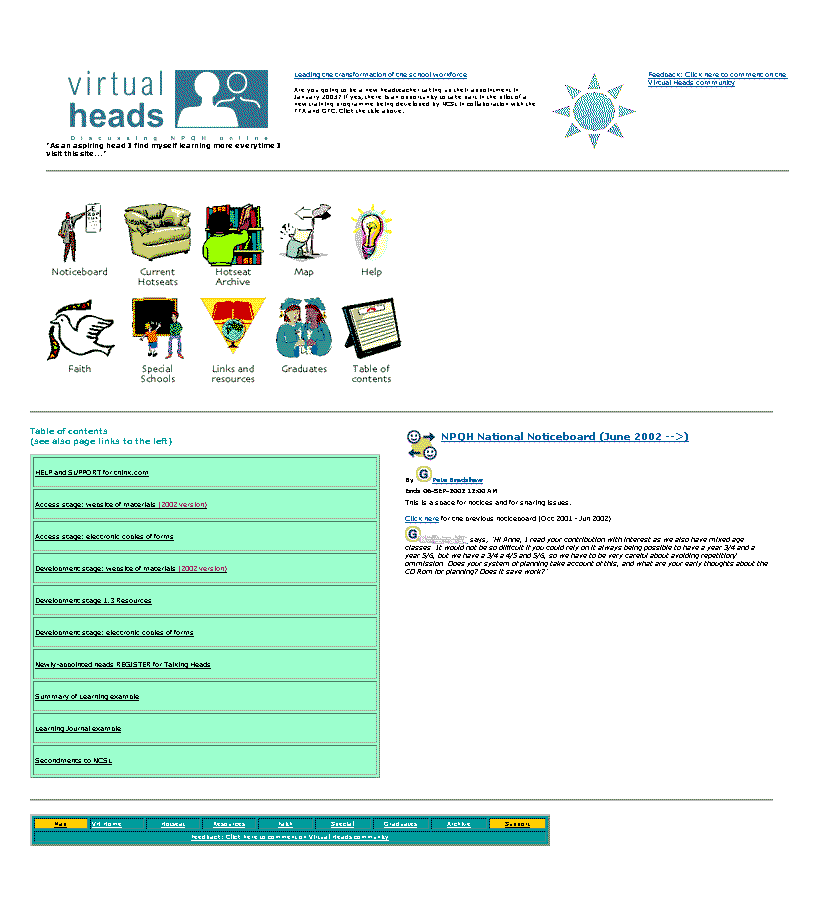
Image
3.1 Virtual Heads layout, June 2002
3.9
Strategy 6: Modelling behaviour and presence
The
online environment is stark. Lacking in visual clues as to expected behaviour,
learners may be reluctant to contribute. Teachers model this expected behaviour,
building trust and encouraging learners to emulate, through answering questions
and engaging in dialogue building on learners' comments but without dominating
the discussion.
"Some
good thinking going on here! ... How do you make a vision equally clear and
internalised by everyone in the school community? How do you keep it in front
of people week by week?"
(An
NPQH tutor responding in a summary of learning, Feb. 2002)
This
allows for a flow in the conversation in which learners can test and develop
their ideas.
Conversely
if a teacher is not seen to be actively contributing to a discussion, but
merely reading, then the learners are not likely to want to contribute, or
the discussion may end, learners becoming frustrated:
"It
seems a long time since we started the NPQH and I am feeling a little isolated
and panic will set in soon! I have had no communication from anyone."
(A
learner writing in her journal, Nov. 2001)
Tone
is equally important. A comment made by an NPQH tutor whilst learning on another
course stressed the importance of being positive to learners:
"I
was thinking how good I felt when you said really nice things about me (online)
I didn't praise my candidates obviously enough and I noticed the number of
contributions went up, so did the quality, when I started being very direct
with praise."
And
having a positive and enthusiastic attitude towards the environment:
"I
am part converted! My healthy scepticism of the success is shrinking as a
result of my candidate's interest and varied use of the medium. I am of the
view that communicating ideas, thoughts, aspirations etc. is the way ahead
and a desirable habit for the profession as a whole."
(A
tutor writing in the Good Practice community (Feb. 2002)
In
cases where online teachers are not present learners may continue to post
but not explore the learning points in depth, or may go off at a tangent.
Equally if the teacher posting is "too long, too descriptive and
too academic...." (Interim Quality Assurance report) learners will
find it difficult to contribute. Making it easy for learners to contribute
in the early stages is essential and this is best done through real tasks
which draw on the learners experience. For example in NPQH learners are first
asked to contribute with a description of their school, and their vision for
future schools, before moving onto the learning materials.
Online
teacher comments need to be made as explicit as possible. Ambiguities can
be heightened without the other clues of body language and context and by
the time delay caused when using asynchronous discussions. In a face-to-face
situation misunderstandings can be cleared up immediately. Online they need
to be avoided in the first place.
3.10
Strategy 7: Taking account of the role being played in the learning environment
While
it is important for teachers to be active in conversations, they need to have
regard for the various roles that they are playing. In modelling online behaviour
they are coaching, in being part of the conversation they are also learners:
"Oh
I really like this.."
"Two
things in this that set me thinking further...."
"Like
your postscript!!! I will try to get balance in due course... Does that mean
that you think I am wrong about the danger of routinisation?"
(Comments
from a guest in a hotseat, in response to questions)
This
peer learning is also a way of reinforcing behaviour. When a teacher affirms
their learning, it will encourage others to reflect on their own.
But
a teacher is also a teacher, an expert. In the learning environment, this
is usually seen in the opening remarks and stimuli:
"Let's
start with examining the link between learning and schooling............ Having
considered both the 'challenges' and the 'statements', what would be your
priorities for children's experience of schooling? How might you lead staff,
governors, parents and pupils towards your vision of what school should offer
children?"
(NPQH
tutor opening a conversation, Mar 2002)
but
should also be seen by online teachers challenging learners in a non-threatening
way, to deepen knowledge and understanding
"Can
I push you a little further on this"
(NPQH
tutor in a module discussion group)
and
tactically intervening to make learners think:
"Isn't
it dangerous to have a vision, especially if it is your own? How do you know
that you know what is best for children?"
(NPQH
tutor in a module discussion group)
This
role is also the one played by guests in the hotseat. As experts they draw
learners into the discussion and provoke them to ask questions. This strategy
of teacher-as-expert is one that can be exploited in any learning situation.
Here a NPQH tutor redefines her role by setting up a local hotseat, mirroring
the style used at national level:
Q:
(from learner): "How much is a small school allowed to rely on untrained
LSA's to deliver special needs teaching and tutorial support? Is it merely
a judgement made by individual school's?"
A:
(from online teacher): "There's not a simple answer to this. Fundamentally,
the issue is about the QUALITY of the provision, which forms part of the teaching
programme within the school. ....... The teacher should direct the work of
the LSA through planning work that builds on pupils' prior learning and monitoring
the progress pupils make. Clearly the school should make arrangements to determine
and meet the training needs of support assistants and ensure they are appropriately
briefed.......Teachers should be mindful of the pay differential between themselves
and support assistants and take responsibility for pupils' learning in a 'reasonable'
and 'professional' manner. Good support assistants are worth their weight
in gold!"
(An
exchange in a hotseat, November 2001)
In
this particular example, there was a change of role but not a change of overall
structure of the learning space. This hotseat has not knowingly resulted in
an increase in participation but provides a good example of a change in role.
The lack of responses in this particular space needs to be addressed by lessons
learnt about structure.
The
type of discussion, can vary but care needs to be taken as to what is appropriate
to elicit the desired outcome. An exchange when 'Sharing Good practice' in
the community of that name included the following:
Tutor
A
"My
informal monitoring tells me that Brainstorms generate more candidate contributions
than other types of 'activities... ' include one for each unit. It helps the
less confident candidates."
Tutor
B
"I
agree, the brainstorms seem to be popular. I also have found that the activities
related to what people already know or feel are easy to respond to and have
a quick take up. The activities that are related to the set activities from
the unit workbooks, that demand that the candidates do some preliminary work
first, are less quickly taken up - this sounds obvious. It makes me wonder
whether the time that is given for each of the units is tight or whether longer
should be given for completion of each unit."
A
discussion that led to a great many in-depth contributions was in the form
of a conversation. The target audience was intentionally limited to learners
teaching in a particular type of school but learners from a wide variety of
backgrounds made valid and useful contributions on a topic relevant to all.
The question was brief (nine words only) and elicited 184 responses (see appendix
for more detail).
3.11
Styles of learning and teaching
Learners
have different preferred styles of learning as already referred to in section
one. Adult learning should be problem-centred and not content-centred, Stephen
Heppell (2001) comments "In a world awash with content and information
the teacher's ability to annotate that information and to develop a critical
awareness in learners seems to be invaluable".
The
provision of content is not sufficient for adult learning. Online learning
provides community and connectivity which has primacy of importance.
Online
teachers need to consider the structure of the environment and activities
to provide for the needs of these different learning styles. The assimilative
will need ample resources at the start of a programme, whereas the activist
will need to have opportunities to join discussions at the first possible
opportunity.
"I go in for a purpose but find I often learn
more by following a whim or checking out something that interests me...all
of which takes time that I don't have. I believe I am also an activist/theorist
but doesn't that cover all the options."
"The
medium should enable you to adopt your own learning style. I am drawn to a
theoretical base/models first so I prefer to read a paper/article first and
then join a conversation. I suppose someone with a preference for action might
join in a conversation first and see that as a stimulus."
"I'm
highly curious by nature and need to get an overview of whole picture up front
- that's my preferred learning style (Gestalt theory of perception)... therefore
I went through every page/link/space that (the course) had on offer and felt
satisfied/comfortable when I'd done the tour."
(3
NPQH tutors who are participating in a course as learners)
Teachers
also have their own style and just as in a face-to-face situation they should
use the online space to give an insight into their personality. An analysis
of two NPQH tutors 'Shared Learning Spaces' undertaken in June 2001 demonstrated
that different tutor personalities lead to the use of different online tools
and different structures in the space but on similar learning contributions.
As
well as matching the personal style of the teacher, it is important that any
programme materials and associated activities are adapted to suit needs of
learners and contexts, and provide complementary online discussions.
If
activities are lifted from another source and embedded verbatim in the online
learning space, those which are inappropriate for an online context automatically
fail. Similarly if questions are too complex they will fail. Those questions
most likely to succeed (based on an analysis undertaken for Talking Heads)
are those which contain one question, are short and straightforward. For example:
"How
do you think your school benefits or could benefit from being involved with
IIP ?"
(An
additional activity from unit 3.3)
If
a blended learning approach has been taken, as was the case with both NPQH
and the Certificate of School Business Management Pilot programmes, all learners
will need support in reinforcing the links between the different aspects of
a programme - for example the materials, conversations, activities (online
and work-based), face-to-face training and assessment. Without this linkage
there is the danger that some learners will regard the online aspects of learning
as an extra and the variety of opportunity will be regarded as a burden. Here
an NPQH candidate comments in a summary of learning and links to two other
aspects of the programme.
"Thanks
for your contributions to On-Line Discussion Modules. Have you read Barbara
McGilchrist's Hotseat article?"
(Tutor
comment Oct 2001)
Some
learners do not value the online element of the NPQH programme because it
is not formally assessed:
"I
think that some tutors, candidates see face to face and assessment as their
priorities, and online as not. It is an issue for <organisation> to
make the online part count - at the moment if you do not log in, it doesn't
matter."
(Tutor
comment, May 2002)
This gives the message that it is less important than other aspects and when
busy professionals are forced to choose which elements to concentrate on the
online community aspect will receive low priority.
One
of the main issues is learners having difficulty managing their own learning.
(Tutor
comment, May 2002)
3.12
Summarising, flow and threads
As
a discussion builds up online it can become difficult to follow. This is due
to the volume of information and to the number of topics that may be raised
in any one conversation. The teacher should take responsibility for summarising
as the conversation progresses, the final summary and for starting new threads
as appropriate. The managing and navigation to these new threads will also
need care if the learner is not to be overwhelmed or confused.
"Thanks
for all the contributions. Three strands are appearing..".
"You
seem to be valuing IEPs and have suggested ways of reducing the bureaucratic
load."
"(name) identifies benefits for the whole school
arising from the Gifted and Talented provision, and also hints at the coverage
across the curriculum. How do others see this?"
"How
does the Portsmouth guidance cited by (name) strike others - is the distinction
between gifted/core and talented/non-core useful?"
(Summary
and question to move conversation on)
"The other issue, that of summarising is also
key... we will be summarising as we go... we may even invite others to make
their own summaries... for whose summary is the most appropriate/accurate???
Sometimes I have been thanked profusely for summarising key points, at other
times folk have complained that I have missed things!"
(NPQH
comment on summarising in discussion, course for tutors (Feb. 2002)
"I
agree it is a good idea to share the reading and post summaries but a different
tack. I have just had a look over the resources for this unit [ie I need an
overview] and found the scale daunting. Initially this was off putting [ I
think other learners may react in this way] but I am beginning to grasp the
significance of the net to learning. So much is out there, the secret is having
the key to find it. The bonus in this situation is having a group to check
out understandings."(
Learner
comment on volume and navigation, course for tutors (Feb. 2002)
By
providing a summary the signal of closure is made and the learning can move
onto the next topic. Online there is a lack of the distinct start and finish
evident in face-to-face learning. These 'drumrolls' (Sloman, 2001) need to
be provided by the teacher.
If
a learner makes a point that suggests a new thread then they can be further
empowered by taking responsibility for developing the new topic themselves.
"I
would like to hear more about my fellow participants experience as online
learners and what they felt motivated them to participate (could include this
module)."
"Thanks for the prompt on motivation, and your
brainstorm on it. If others would like to contribute to this brainstorm it
can be found on the unit 2 or click here."
(Learner
suggestion and response from teacher, tutors course Feb. 2002)
They
should also be encouraged to summarise their learning and any conversations
they are responsible for. A danger here though is that the more reflective
may produce summaries of learning without contributing to the active learning
discussions.
"I
have noticed that there are a number of candidates who contribute to the national
hot seat debates fairly regularly and a number of candidates who are actively
engaging in the centre module discussions. But unfortunately it is not a high
percentage of our candidates who are making any contributions."
(NPQH
centre manager in discussion with tutors)
3.13
Giving feedback
It
is imperative that learners receive feedback on their postings and reflections.
A learner who does not take active part is not present, neither is an online
teacher.
"One
candidate made 38 contributions without the tutor responding on the tutorial
noticeboard. Regular contributions by the tutor to the board appear to result
in a more responsive tutor group."
(University
of Manchester Bursars evaluation report (May 2002)
Many
learners faced with an absent teacher will drift. Care needs to be given to
the style of this feedback. This can be done in the online space so that all
learners can read it or can be one-to-one to allow for privacy of response.
The table shows the number of postings in learners' Summaries of Learning
for two tutor groups.
A
further consideration is the style and length of response. Just as a long
or complex question face-to-face deserves a reasoned response so online a
brief remark may be seen as off-putting to the learner. Conversely, if a long
response is given to a short question it may induce the expectation that the
next question must be of length. This can be difficult and the conversation
may stall.
3.14
Conclusion
Teaching
in an online context is not that different, from teaching in a face to face
environment, although the ability to 'slip time' does mean that strategies
to get learners to participate have to be broken down and made explicit. Our
examination of NPQH tutors 'Shared Learning Spaces' and Bursars tutors 'Online
Tutorial Groups' have demonstrated that a sympathetic strong and imaginative
teacher is able to transfer those skills online. Being interested in learning
they are often willing and enthusiastic about transferring their skills and
welcome the challenge of a new context. However the starkness of the online
environment exposes those teachers who fall back on dissemination models,
or often absent or not in sympathy with their learners. There is no hiding
place online for weak or ineffectual teachers.
Learning
online gives new opportunities for teachers to expand the programme and this
is being increasingly recognised by those online teachers in both the NPQH
and the Certificate of School Business Management Pilot programme,
"NPQH
online goes over and above the content. It is about learners' professionalism,
expertise and experience. It provides a wonderful opportunity for candidates
to share."
(Tutor
comment, May 2002)
Section 3: Appendix
Analysis of discussion in Virtual Heads
-
The title of the discussion was: "What
do you do in your school about vision?".
-
It was started on 1st October
2001.
-
The discussion starter was: "Are
there any strategies for turning vision into practice that you would like
to share with others?"
1. Summary
of Quantitative Data
The
style of the discussion was as a conversation. The number of contributions
to the conversation attracted attention. An overview of some of the quantitative
data is presented below (Table 3.1).
Quantified
Items |
Quantity |
|
|
Start
Date |
1/10/01 |
Archive
Date |
6/3/02 |
End
Date |
31/3/02 |
|
|
Number
Contributions |
184 |
Number
Participants |
167 |
Number
Re-participants |
12 |
Number
Males |
55 |
Number
Females |
106 |
Number
Gender unknown |
6 |
Expressions
of Thanks |
12 |
Re-participants
Expressing Thanks |
3 |
Table 3.1. General Quantitative
data.
2.
General Observations
There
were many contributions that satisfied the opening remark and also expressions
of appreciation for such contributions, for example
"If we are honest, we would say that the vision
for the school is driven by the headteacher. We all recognise that the other
stakeholders need to consulted, but ultimately the headteacher leads/manages
the school and as a result needs to move the school forward in a way that
they think is right. Show me a headteacher that strives for a vision that
they do not believe in! So how do we get others on board? Perhaps you could
ask all the stakeholders, including the parents (you will have to expect criticism)
what three things could we do to improve the quality of teaching and learning
in the school? You may find the results interesting! But it will give you
an insight into what stakeholders want from the school (their vision)."
"Your vision must reflect your values so surely
these would be apparent in whatever kind of school you find yourself. You
will find that processes and outcomes will vary but the vision lives on. I
do like the idea of three key points from all stakeholders to drive a vision
forward. Thank you for that."
There
was also much discussion and exploration of vision itself. E.g. defining,
interpreting and exploring vision as the example below shows:
"Thanks to everyone for their insights- they
have really helped me in my thinking. Isn't vision simply "WHAT I BELIEVE"
in a school/headteacher context? I thought Suzannes comment about walking
ahead...is true- its about leading and checking that the track is still clear
enough for everyone to see where they are going."
Many
heads also used the discussion to raise their own issues, difficulties or
problems rather than for sharing strategy. Many of these contributions received
responses however there was little re-participation to say if these responses
were useful.
A
number of recurring themes emerged from the discussion. These are shown in
Table 3.2 together with the number of times they recurred. These could be
arranged in more general themes; management issues, clarifying vision, effecting
vision etc.
Recurring
Theme |
|
Recurring
Theme con't |
|
|
|
|
|
Ownership |
115 |
Managing
change |
14 |
Heads
role in process |
61 |
Faith |
14 |
Continual
re-evaluation |
45 |
No
vision |
10 |
Exploring/defining
vision |
41 |
Busy
staff/heads |
8 |
The
children |
36 |
Managing
conflict |
8 |
Communication |
32 |
Managing
vision skeptics |
8 |
Creating
or inheriting a vision |
31 |
Celebrate
achievements |
6 |
Mission/vision
statement |
23 |
Others |
9 |
Consultation |
16 |
|
|
Reference
to module or f2f training |
16 |
Total |
493 |
Table 3.2, Recurring themes in discussion.
3.
Evidence for Community
Evidence for community was seen in contributions after
they were classified according to Table 3.3 below.
Categories
of Indicators to Community |
Number |
|
|
Me and my school |
87 |
Disclosure & Venting |
34 |
Agreement or reference to other participant |
109 |
Ownership (proposing actions) |
42 |
Table 3.3, Classification of contributions for evidence
of community
- All 184 contributions were analysed, most were
assigned classifications according to Table A3.3.
- Approximately 80 contributions displayed multiple
entries, i.e. two or more different indicators of community within a single
contribution.
- 90-100 contributions had a single entry in the
community section.
- 10-15 contributions showed no indicators for community.
above.
4.
Evidence for Learning
The categories in Table 3.4 (below) are indicators of
learning. Contributions to this discussion were analysed for these indicators.
Categories
of Indicators for Learning |
Number |
|
|
Reflection of what has gone before - enthusiastic
/ agreeable reference to prior contributions. |
39 |
Learning - explicit references to learning, |
11 |
Impact, change -" as a result of this I will/have"
The hotseat has caused change to happen |
2 |
Table 3.4, Classification of contributions for evidence
for learning.
- All 184 contributions were analysed, 50 were classified
as in Table 3.4.
- Only 2 contributions displayed multiple entries.
- 48 contributions had a single entry.
- 137 contributions showed no indicators of learning.
5.
Gillian Salmon's Taxonomy of Active & Interactive Thinking
- 97 contributions were analysed using an adaption
of G.Salmon's taxonomy. These were the first 94 contributions (2 were duplicates)
and the last 5 contributions.
- The effectiveness of the modified taxonomy is being
investigated with a view to future use in discourse analysis. It is likely
that it will be further modified.
Table
3.5 (below) shows the modified taxonomy and the results of the analysis using
the modified taxonomy. Each item in the taxonomy has been coded, all later
references to the taxonomy will use this code.
The
three major changes are defined in the 'comments' column. They were introduced
to suit the nature of the data, specifically to facilitate the process of
discriminating between categories. In doing so the number of multiple entries
(of codes for contributions) was reduced. However the analysis still recorded
multiple entries because while this makes interpretation of the totals more
complex it provides extra depth and detail as compensation.
| |
Taxonomy Category (adapted from G.Salmon) |
Notes |
Single Entry |
Multiple Entry |
Total |
| |
|
|
|
|
|
| S1 |
Offering
ideas/ resources and inviting critique of them |
|
1 |
7 |
8 |
| S2 |
Asking
challenging questions |
|
3 |
18 |
21 |
| S3 |
Articulating,
explaining and supporting positions on issues |
Raising an issue |
6 |
9 |
15 |
| S4 |
Exploring
& supporting issues by explanations & examples |
Congenial reply |
31 |
32 |
63 |
| S5 |
Reflecting
and re-evaluation ones personal position |
|
0 |
4 |
4 |
| S6 |
Critiquing,
challenging, discussing & expanding others' ideas |
Adversarial reply |
1 |
14 |
15 |
| S7 |
Negotiating
interpretations, definitions and meanings |
|
1 |
10 |
11 |
| S8 |
Summarising,
drawing together threads |
|
3 |
7 |
10 |
| S9 |
Proposing
actions on developed ideas |
|
1 |
15 |
16 |
Table 3.5, Adaption of G.Salmon's taxonomy and summary
of the analysis.
The
column 'single entry' shows the number of contributions that are entirely
defined by each code. 'Multiple entry' shows the number of contributions that
are partly defined by each code. For example, code S2: 18 contributions were
partly defined by containing challenging questions and partly defined by one
or more other Salmon categories; whilst 3 contributions were entirely defined
by code S2. In total 21 contributions had S2 assignments. The frequency of
single and multiple entries is shown below (Table 3.6).
Contribution
containing... |
Number
of occurrences |
|
|
Single
entry |
47 |
Double
entry |
37 |
Triple
entry |
10 |
Quadruple
entry |
3 |
|
|
Total
number of contributions |
97 |
Total
number of entries |
163 |
Table 3.6, Summary of single and multiply entries for
Salmon analysis.
heppell.net