Section
4
Learner
learning
This
section analyses and discusses the online experience of learners in the NPQH
programme. ICT and online learning tools have been used to provide learning
opportunities in programmes. As well as having an impact on the learning objectives
of the programmes, the use of ICT results in learning gains in the use of
the technology itself. This aspect of learning, supplementary to the main
aims but valued by learners, is considered at the end of the section.
4.1 Expectations of online learners in NCSL programmes
-
Online learners are professionals who need
to take responsibility for their own learning.
-
Online learners should contribute to discussions
and reflect on the learning that comes from the discussions.
-
Online learners should post summaries in
their learning groups, and comment on others in their learning circle.
Simply reading hotseats and online discussions is a
valid way of learning but this learning needs to be drawn out in the summaries
and assessment processes.
The
online elements of the NPQH programme consist of four distinct elements
-
Resources
and websites of materials
-
Overarching
spaces for national discussions, hotseats and administration
-
Asynchronous
regional discussion forums
-
Spaces
for learners to share learning with peers and teachers
For
a programme to be successful these elements must be coherent and, crucially,
the online element must not be seen as an extra but must be central to the
process of learning and of assessment.
In
this section the impact on learning of each of the sections is considered
in turn.
4.2 The impact of online work on learning
The majority of online learners report that they find
one or more of the online aspects useful (see Table 4.1 below). Frustrations
occur when material is not available for them to contribute to, or when their
contributions go unanswered. These frustrations are often voiced in a need
for more face-to-face meetings (see the end of this section), a natural reaction
but one which needs to be first addressed by ensuring that discussions are
available, interesting and relevant.
59
cohort 1 NPQH learners were surveyed in July 2001 and asked which of the elements
they found most useful to their learning.
The
results showed that they found the national overarching elements of most use.
Online element |
Hotseats |
Website
of materials |
Regional
discussions |
Learning
space |
| Number
of mentions |
26 |
21 |
6 |
13 |
Table
4.1 Responses to 'Which element/s do you find most useful?' July 2001
The
most often stated reasons given to explain the usefulness of these elements
to learning were:
-
Reducing isolation,
networking across a larger area,
-
Exposure to remote
experts
-
Wider
range of case-study Headteachers
- Availability
of hyperlinks to materials
-
Feedback
from tutors and others
-
Being
able to work at own time and pace
Hotseats
and the website of materials are the two most popular elements. It is these
two elements that allow for the more reflective style of learning with learners
being able to spend time reading, rather than contributing.
To balance this it is necessary to take a more proactive
approach in the learning spaces and discussion forums where teacher and learner
are engaged in discussion. The resulting restructuring of summary of learning
groups, following the survey and feedback from centres, has allowed more sharing
of learning.
4.3
Logging in rates
For the induction to Cohort 1 in February/March 2001,
there was no requirement for learners to log in. Indeed, few induction tutorials
were held in venues where this was possible. This caused problems with learners
subsequently not being able to access the online components.
"Demonstration is not sufficient. Learners
need to have hands-on experience so that they can feel confident of expectations
and how to fulfil them. "
"(This implies the need for) clarity for tutors/learners
re what expectations are (i.e. how often people log on, what they post in
summary of learning, how they contribute to online tutorial groups."
(NPQH Centre Manager reflecting on Cohort
1 inductions)
As a result of this lack of hands-on access, there were
a significant number (1 in 14) of learners who had not logged in after several
weeks. After the experience of this cohort, centre managers revised their
approach to the induction tutorials so that by Cohort 3, the requirement to
log in and experience the online environment was central to the tutorial.
Following the introduction of integrated ICT in the recommended agenda for
induction tutorials (cohort 3) the log in rate for all learners had increased
to a level at which virtually every learner had logged.
| Cohort |
Log on rate |
| 1 (spring 2001) |
93% by April 19th |
| 3 (spring 2002) |
98% by March 22nd |
Table 4.2 Log on rates
4.4
Summary of Learning Areas
In
Cohort 1, the summary of learning community was shared between one tutor and
one learner. This required the tutor to set up and manage a large number of
communities, maybe as many as 30 if they work on both Access and Development
stage. Across the country this resulted in some 2000 communities, with a consequent
problem of navigation and location of previously-visited conversations. In
some cases, where participants provided impressive Summaries of Learning these
were locked in 2 member community isolation, unshared and uncelebrated. This
was completely contrary to the philosophy of both community and the programme,
which emphasised collaboration and shared learning.
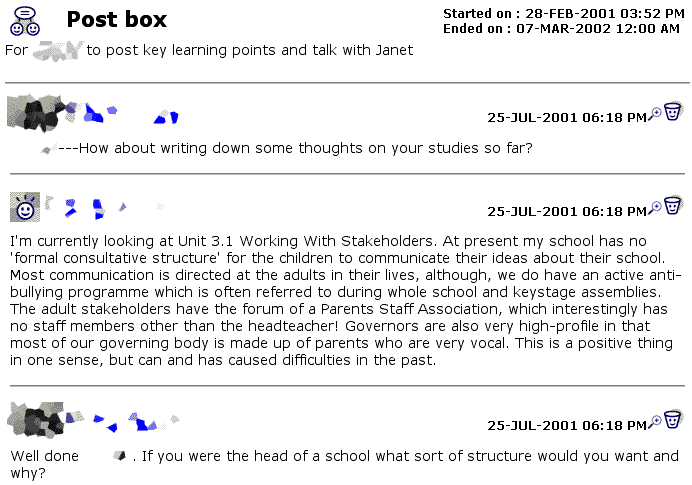
Image
4.1: A Cohort 1 summary of learning, showing little interaction
Often
learners did not know how to post to their summary of learning space, as this
had not been covered in the induction tutorial. With so many communities to
visit, successful posts were often not seen by tutors for some time.
"Learners
need more expertise than they have, in some cases, to publish something
on their summary of learning page. Tutors need, in some cases, more expertise
than they have to seek out contributions that are languishing in the gallery.
The result is that learners feel aggrieved that no-one is responding to
their work, and tutors feel disheartened that no-one is posting anything."
(Centre Manager commenting on use of summary of learning
spaces in Cohort 1)
This
structural issue was addressed for Cohort 2, by combining the summary of learning
spaces of all learners that shared a tutor to form a 'Shared Learning Space'.
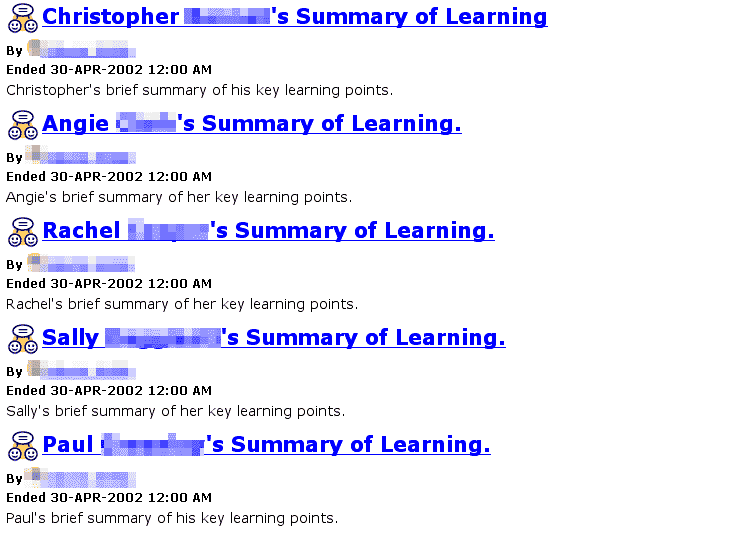
Image
4.2, Example of a shared learning space, increasing interaction via a shared
single page
As
well as making the navigation for tutors easier, the reduction in the number
of Summary of Learning Communities (from approximately 2000 to 250) meant
that they could be set up centrally in each region. This meant fewer errors
and less problems for learners in finding their spaces. This had been a major
source of frustration for cohort 1 learners:
"The
site is hard to navigate"
"I
have too many communities"
"I got sidetracked by the navigation and found
the focus hard, it is not user-friendly"
"I
could not find the units online"
(Comments from candidates in Cohort 1)
Versions 2 and 3 of think.com and the simplified structure
of communities were both welcomed, and are having a positive impact on online
learners' use of these spaces. In Cohort 3, four Summary of Learning Spaces
were analysed. Over 75% of candidates make regular use of their summary of
learning, posting a summary at least once a month. In cohort 1 the figure
was under 50%.
Learners' responses often reflect the attitude of their
teacher to ICT and online teaching.
"My summary of learning space is
the most useful as my tutor is great."
"My summary of learning space is
fantastic - my tutor's response provoked me."
"I was enjoying my summary of learning
until I realized I had made a mistake, now I am too frightened to use it."
"Interaction with my personal tutor
has been limited. I'm not sure how confident he is with online input!"
(Comments
from candidates about their Summary of Learning Spaces)
4.5
Hotseats
From
the first hotseat run by Michael Barber the hotseat programme in NPQH has
been hugely successful and there is ample evidence that online learners in
NPQH are using the archive to further their learning:
"When
I was studying unit 1, the hotseats really affected my thinking."
"Tim
Brighouse made me think hard, the hotseats change the way I think."
"The
hotseats are really interesting and accessible, I'd never meet (the hotseat
guests) in real life."
"Some learners have been quite engaged by the
hotseat debates, which I regard as one of the biggest selling points of
the site."
(Centre manager comments on hotseats, Cohort 1, June
2001)
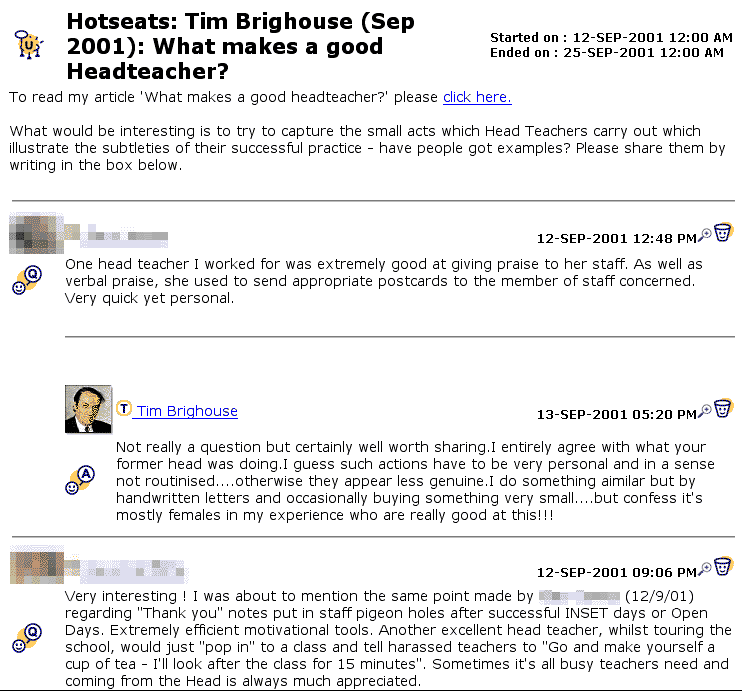
Image
4.3, Hotseat page with Tom Brighouse
Conversely
learners have high expectations of the hotseats and become frustrated when
the discussions are not easy to follow:
"The
hotseats are not productive. I've only been in 4 times because they are very
long-winded and frustrating."
One
of the aims of the review of the NPQH programme model was to provide interaction
with serving headteachers. This is appreciated by learners:
"Ones
with real heads are best... "
"The
best hotseat was the one with the teaching head... "
"The
head of the special school raised my awareness of SEN issues... "
Another reason cited for their popularity
is their involvement of a large number of fellow learners:
"They
allow me to get a wide range of different viewpoints and perspectives."
"It
is good to share with existing heads and fellow candidates."
Conversely
though, some candidates feel this constrains their use of this forum:
"The
hotseats are interesting to read, but I feel vulnerable in a big group."
(Learners'
feedback, July 2001-June 2002)
The
archive provides a dynamic supplement to the materials website. In compiling
the archive an index has been created that collates the hotseat summaries
according to the module that they address. Links between the programme materials
and hotseat discussions are being explored in the rewriting of the materials.
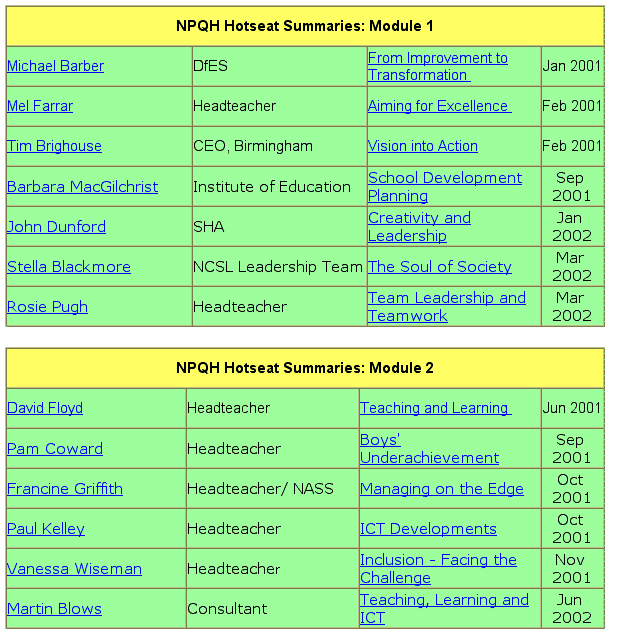
Image
4.4, hotseat archive
The
hotseats were initially envisaged to cover two aspects of learning:
- Case study material led by existing Headteachers
-
Expert hotseats led by regional and national
figures
In
parallel to this model, the questions and answers were initially of the 'learner-expert'
type, with learners asking direct questions and not reflecting on their practice.
As the hotseat schedule proceeded the questioning became more reflective.
Several
hotseats have been analysed for this change of style. Evidence of learning
based on learners moving from stating what they do now, through reflection
on others' comments to direct expression of a change in practice. The figures
for this last type of question are suppressed as few learners ever return
to a hotseat to report back such change of practice.
4.6 Analysis of learner contributions
to hotseats.
Four
categories for the contribution of learners were recorded. These are subjective
categories, the criteria determining each is shown in Table 4.3 below. It
should be noted that it's common to find contributions that fit into more
than one category.
| Hotseat guest as expert; case study |
Mainly Q & A - talking about the hotseat
guest's own school, their expertise. |
| Me and my school |
The contribution is characterised by the
learners repeatedly referring to themselves, their school or their colleagues. |
| Reflection of what has gone before (learning) |
Reference to other questions/answers.
Mention of others, explicit references to learning. |
| Impact, evidence through actions |
"As a result of this I will/have...
" The hotseat has caused change to happen. |
Table 4.3: the four categories
of contribution from learners in hotseats.
Exemplars
were collected for three of the categories, the exception being 'Hotseat guest
as expert'.
The
figures that relate to the categories are in Table 4.4.
| Hotseat Guest |
BM |
DF |
PS |
GG |
TB |
TOTAL |
| Hotseat Guest as expert/case
study |
10 |
9 |
6 |
1 |
18 |
44 |
| Me and my School |
13 |
25 |
7 |
7 |
10 |
62 |
| Reflection on previous comments
(learning) |
14 |
21 |
9 |
7 |
19 |
70 |
| IImpact, evidence through
actions |
1 |
0 |
0 |
2 |
1 |
4 |
| TOTAL |
32 |
51 |
22 |
12 |
46 |
180 |
Table 4.4: Categorisation of
learners' contributions to hotseats.
Clearly learners are not reporting
impact in the hotseats. This may again reflect their national status and their
phrasing in question and answer with a guest. The impact on actions is a specific
requirement of the school-based activities, which are reported on in candidates'
summaries of learning. It is interesting to note, however, that learners are
interacting with each other, reflecting on each others' comments and on their
situation and their schools, with over 70% of contributions falling into these
two categories.
Examples of comments showing
impact:
"... This morning I gave the Head an idea of what development
planning actually was from your work and that of (name). It looks like we
are due to have a big inset on the whole issue and I have been invited,
as a non SMT member, to produce a model for staff discussion."
"... I feel that I am at an important stage in my own learning
- proximal development etc. - and the crucial task now is to consider what
impact ICT has had so far on our pupils' learning, apart from their obviously
improved skills, and what impact it could have in the future... I think
your advice has in the meantime shown me a starting point - I need to share
these ideas with the rest of the staff and identify a 'project'... "
"Thank you for a very apt and succinct summary of Headship,
particularly the 5 essential qualities. I intend to refer to these in any
future Headship interview! They must underpin all the other little gestures
and actions too, because if the relationship is not based on trust and respect,
a Head's ostensibly kind and supportive actions will be treated as anything
other than that... "
(Comments from learners in hotseats, Feb-Aug 2001)
4.7
Materials website
Each
module emphasised reflection and 'cued' online learners for the reflective
experience. The materials website consistently linked back to the online community
and gave online learners the opportunity to develop a pedagogy based on dialogue,
discussion, collaboration and sharing best practice within the communities
to which they belonged.
Thus
the materials website was consistent with the changed philosophy of the NPQH
programme; this was not a managed learning environment in which control resided
in the programme team, but an information tool through which the pedagogical
thinking residing in the programme (self-directed learning, continual professional
development, collaboration, sharing best practice and criticality) could be
best implemented.
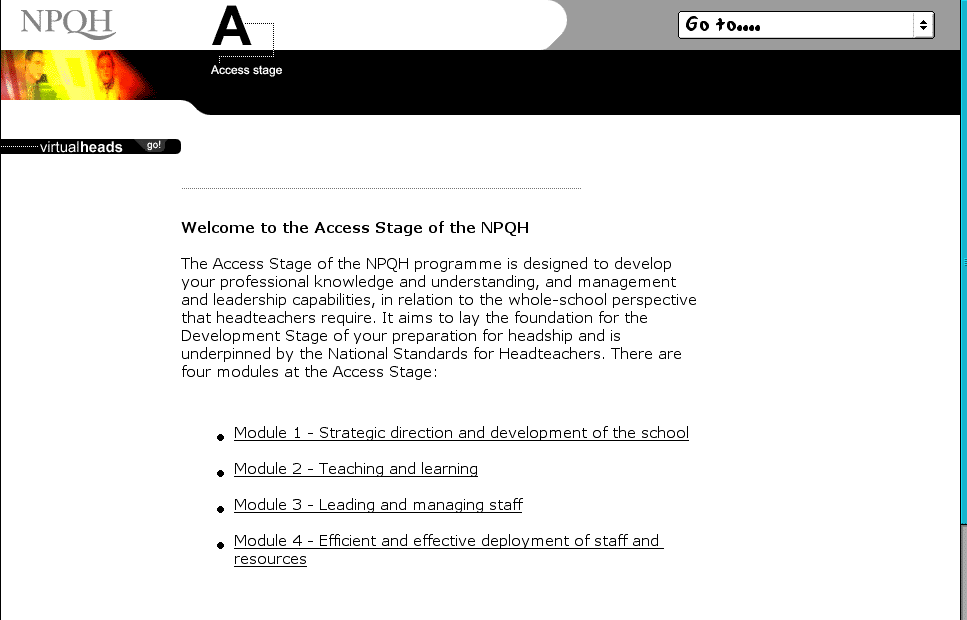
Image
4.5, materials website
The
NPQH learners had access to the materials in paper form as well as on the
website. Both of these formats are valued.
"The
paper materials are wonderful... "
"The
website materials and their links are very convenient... "
"The website is the most useful, especially
its links to information e.g. in the unit on governors"
(Feedback from learners, July 2001)
From the launch of the new model of NPQH
the website of materials has attracted a large number of visits with each
visitor spending some time browsing and reading a number of pages.
Duration
of logging: 8 months
Number
of page hits: 119,000 (exactly)
Number
of sessions *: 10198
Number
of pages per session: 11.7
*
a session is defined as a visit by a user from logging into the site, to
leaving
it.
4.8
Module discussion groups
Known as online tutorial groups in Cohort
1, these provide a space for learners across a region to share in discussion
with the regional tutor team.
"The Online Tutorial Groups are not
going down particularly well for various reasons
-
Tutors - expertise in putting the right
things in the right place
-
Learners
- reluctance to put themselves "out to dry" as someone said to
me today. Can't help feeling that future heads ought to have the courage
of their convictions, but clearly in some cases they don't. That's an issue.
-
Until
we reach "critical mass" in contributions, those who don't contribute
feel disappointed at the lack of interaction"
(Centre manager comments on Cohort 1)
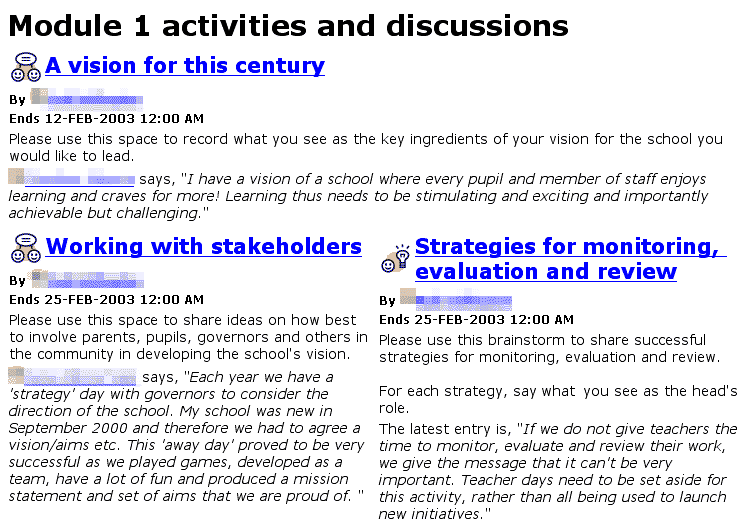
Image 4.6, module discussion group
4.9 Centrality of online elements to
learning and assessment
From the outset, online work was seen by
a 'core' of online learners as an integral part of the programme. Many of
the early complaints concerned the inability of learners to find appropriate
online spaces, either due to the failure of online teachers to establish these
areas or navigation complexities.
Even in early discussions there was obviously
some reflecting of ideas back into the school situation. Cross-LEA boundaries
aided this discussion. Online learners report they have benefited from access
to a much wider range of ideas online, for example hotseats allow them to
directly interact with experienced headteachers and policy makers and to share
ideas.
In any programme of learning, components
need to be coherent, and seen by learners to contribute to the whole programme,
and to its assessment. This applies equally to the online aspects of the NPQH
learning programme. Without this centrality, learners will become frustrated
and put undue reliance on the face-to-face elements of the programme.
"ICT mustn't be seen as an add on.
It is central to developments in school today."
"I don't like the dependence on
ICT. Yes, it is good to use this facility but I am resigned to logging on
at home, in the early hours as there are too many other things which are
demanding my time. I don't think this is lack of time management but lack
of time!!! Does anyone else feel the same?"
"The face 2 face days were intense
but at least I was able to devote my full attention to them. I know that
being a Head will be demanding but I know I couldn't work harder than I
do at the moment and I am using my time efficiently. Where does everyone
else get the time to log on?"
"With the 'lunch box' modules to study, the
school improvement focus, and gathering the extensive evidence for the school
based assessment, there is no time left."
(Comments
from learners on NPQH programmes, Cohort 1)
"Feedback from learners at face-to-face training
today is very clear. They feel there is too much to do in studying the units
anyway. Add to that the time demands of responding on-line and the whole
things becomes not only unmanageable, but de-motivating."
(Comment
from a centre manager, with Cohort 1)
These issues are compounded if, and when, learners realise
that their online contributions do not directly form part of the evidence
for their assessment. To counter this, many regional centres are asking assessors
to explicitly require learners to produce the evidence so that it may be considered
along with that from the school-based activities.
4.10 Impact of online learning on learner's ICT capabilities
While the emphasis of any online component of a learning
programme must be on the core topics being studied e.g. leadership, management,
learners inevitably report a benefit in terms of their capability with ICT
and the flexibility it brings to learning.
"I
had not used ICT before, and would never have thought of registering online.
Now, I wouldn't think twice about it".
"The
beauty of this is that I can do it at 3am if I like."
"I
can work from home or school, I can fit it in around the needs of my family."
(Comments
from learners, Feb-July 2001)
Indeed, it was from the evaluation of the pre-2001 NPQH
programme, indicating the desire of learners to use ICT in their learning,
that led to the introduction of the online elements in the new model. In the
first cohort, 28% of candidates registered online. This increased to 55% in
the second cohort, as the centrality of ICT in the process became recognised.
heppell.net