Section
5
Lessons
learnt
Through
our experience of the development of programmes for the NCSL, specifically
the NPQH and a pilot of the Certificate of School Business Management programme
for bursars, we have learnt a number of lessons and have key recommendations
for others implementing such programmes.
ULTRALAB's
understanding is based on a number of premises outlined in section 1; namely
that online community discourse adds value to most programmes. This is based
on the belief that discourse within a community context allows participants
to collaboratively reflect, develop and share best practice, unlocking the
tacit knowledge resident in professional learners.
ULTRALAB
have been running assessed online programmes since 1994 when the first online
Integrated Course module for a university MA programme was designed and run
within ULTRALAB. We have been running online communities since 1993. This
report draws on these experiences.
To
date (May 2002) over 6,000 online learners and 517 online teachers have been
involved in the NPQH programme and 100 learners and 10 online teachers in
the Bursars' Development Programme pilot.
5.1
Guidelines for setting up an online programme
At programme inception there
is a need to clarify understanding of all the elements of the programme with
all members of the programme team, including the project leader and material
writers. It is essential to ensure that those designing and developing the
online environment are involved in all the early discussions of any of the
programme's elements. ULTRALAB's experience with the development of NPQH emphasised
the importance of this aspect.
Simultaneously there was rapid
development of the NPQH programme, the materials, the content of the face-to-face
element and the final assessment methods. By the time of the launch of the
new programme, in January 2001, there was little integration of the individual
elements of the programme. For example, although online community dialogue
was a substantive part of the programme and embedded into the philosophy of
the new programme, there was no assessment of the online contributions. It
was apparent to learners that there was no requirement to contribute online,
as demonstrated by the comment by one NPQH tutor below,
"Horrified after I picked
up a discussion 'thread' in Mar01 group that talks of " assessors NOT
wanting to see think.com contributions/discussions as evidence" ( Will
someone please tell me this is not true before I sceam ?) NB Hard copy
print-outs of think.com evidence is as valid, reliable, attributable, as any
other material."
(Comment in
online community from NPQH online teacher)
Participation in the online community
should be part of the assessment process and be regarded as essential; philosophically
this gives the message that contributions are of value and online contribution
is worthwhile. When the Bursars' Development Programme pilot was developed
in January 2002, assessment of the online dialogue was written into the programme
at the development stage. Learners understand that this is essential and consequently
worked to overcome barriers to communication.
"thank you! Please forgive
my pedantry, but I wasn't sure if I was merely confused, or hadn't learnt
properly... (aha! another entry for my Journal -or is that cheating?). duz
ythis program have spellcheck?"
"Don't really want to
post this, seem to be hogging the show, but if you don't ask you don't learn..,
HEY, I've found the spell check, in Preview! (Another L-J entry, heh heh heh...)"
(Two comments
from the same learner in Bursars Count noticeboard)
Demonstration of the value held
by community can be made in a number of ways, including the commitment to
participate by those running the programme.
The elements of the NPQH programme
were seen as standing in isolation. For example there was no extension of
discussions held on face-to-face days into the online community dialogue.
Thus an opportunity was lost to provide an integrated approach for the learners.
The bursar pilot has structured the programme of hotseat guests so that a
presentation is made at a face-to-face event; the slides from the presentation
are made available to learners who are then able to ask questions in the community
hotseat. This gives learners more time to think about their questions and
the speaker can answer when convenient. This integration of the face-to-face
meetings with the online community is a welcome progression, improving the
relationship of the online elements with the face-to-face.
It is essential to ensure that
the programme materials can integrate with online dialogue. The NPQH writing
team had little experience of online learning when the questions to be discussed
were written, hence the activities specified in the modules for online community
dialogue were not always suitable or appropriate. Teachers reworded them or
replaced them with other activities designed to stimulate discussion (see
section 3).
For the development of successful
online community discussion it is essential that the underlying programme
philosophy is in symmetry with participation and dialogue. If the programme
exists in isolation, as in the case of LPSH, then the online element is likely
to fail. Within the NPQH programme, the materials' website was designed to
provide flexibility, thus the underlying database and system of hyperlinks
enabled the online learner to 'follow a journey' through the materials. Online
learners are able to use the materials website to access both the programme
materials and resources and up-to-date information from external web sites,
for example when studying the issues around setting a school budget, the website
contained background information, links to organizations, such as the Audit
Commission, and spreadsheet models that can be downloaded and tailored to
individuals needs.
Each NPQH module emphasised reflection
and 'cued' online learners for the reflective experience. The materials website
consistently linked back to the online community. This gave online learners
the opportunity to develop a pedagogy based on dialogue, discussion, collaboration
and sharing best practice within the communities to which they belonged. Thus
the materials website was consistent with the changed philosophy of the NPQH
programme; this was not a managed learning environment in which control resided
in the programme team but an information and learning tool through which the
pedagogical thinking residing in the programme (self-directed learning, continual
professional development, collaboration, sharing best practice and criticality)
could be best implemented.
There is a need for any programme
to consider the potential learners to ensure that their learning will be enhanced
by access to a learning community. If the philosophy of the programme is reflective
and self directed our evidence is that learning will be enhanced (see section
3).
5.2
The structure of the online learning environment
The
online space for any programme should consist of an overarching space and
spaces for learning, which will have distinct features, to match the style,
aims, objectives and numbers involved in the programme. Both these types of
spaces are discussed in this section.
5.3 Overarching Area
All programmes, including NPQH
and the bursars' Certificate of School Business Management pilot have demonstrated
the need for an overarching area where all online learners meet. This was
established in the early planning of the online aspects of NPQH. This 'central'
place (Virtual Heads and Bursars Count) provided crucial administrative functions.
For example all the necessary programme documents were available for online
learners to download in Virtual Heads, both communities provide a 'noticeboard'
for online learners and teachers to highlight issues, problems and notices.
Image 3.1 (in section 3) shows
the overarching area for NPQH and Image 5.1 that for the pilot Bursars' Development
Programme.
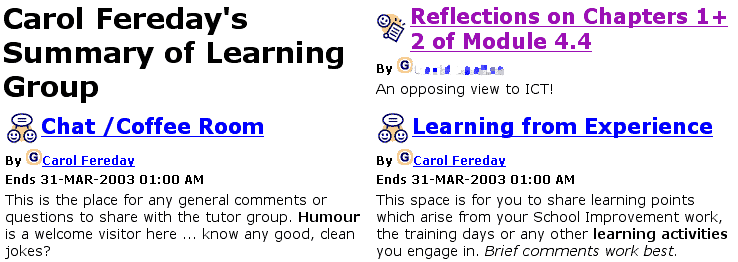
Image 5.1 The overarching area
for the pilot Bursars' Development Programme
All those involved in a programme
belong to the overarching community. This provides for essential access to
a feedback space for the online learners.
5.4 What should an overarching
area contain?
Whilst programmes will vary and
have distinct 'flavours' there are some generic features which can be identified
and should be in each overarching area.
-
Noticeboard, to include reminders
and timelines, and clearly stating that all members including learners can
add notices
-
Links to materials and resources
to support the discussions
-
Discussions with experts. These
may be the online teachers themselves or guests and may be led by more than
one person concurrently
-
Teachers' contact details and
links to their own spaces (if provided by the software)
- Bibliographies
-
Programme guidelines, including
the schedule, learning objectives, assessment requirements
Experience shows that these overarching
spaces are well used by online learners who give valuable feedback on all
aspects of the programme, including design, implementation and materials.
The examples below give two of the many types of feedback from Virtual Heads.
"I'm a new member to
NPQH and was relieved to read that other people are finding it difficult
to get online - I thought it was me/my eldery computer. Finally made it
tonight although I had o make a cup of tea whilst waiting for photo to install....No
doubt it will become clearer in time. I look forward to contributing to
discussions, ask Hotseat questions etc but so far find it a little intimidating.
"
"What
has changed? Tonight for the first time everything worked without me having
to try twice at all and i was on for nearly half an hour. Well done! Is it
the time or a fluke. I hope not because it certainly made a difference to
what i could do in the time. I will let you know if it continues."
(Comments from
online learners in Virtual Heads feedback)
A consistent approach should
be adopted in these spaces, few changes being made to ensure that online learners
can find the information they need with as little waste of time as possible.
Within Virtual Heads, from the programme inception in January 2001 the area
contained a noticeboard, where both online learners and teachers could raise
issues, links to documents and external sites (including the NPQH materials
web site) and the hotseats.
5.5 Programme learning communities
Early learning from Talking Heads
emphasised the importance of limiting the number of places those contributing
online needed to visit to contribute. When the number of places where contributions
can occur is reduced, then less members are viable. Talking Heads participants
polled for feedback frequently mentioned too many places and too many discussions,
as demonstrated by the comment below from a member of Talking Heads,
"I cannot find the discussion
I started to find out if anyone has commented ..... there are simply too many
places to go to and too many overlapping discussions."
(Comment in
personal communication from Talking Head participant to a facilitator)
In the development of NPQH, the
project leaders wished to replicate the face-to-face experience online and
thus created a large number of private communities. For example in January
2001 online learners on the NPQH programme were expected to discuss their
learning in a space designed for one online learner and one online teacher.
This mirrored tutorials in a traditional learning situation These areas were
called Summaries of Learning and the anticipation was that online teachers
would interact with online learners on a regular basis to add advice, expertise,
support and encouragement to the online learner. Each NPQH online teacher
had 12 to 15 online learners and therefore 12 to 15 Summary of Learning areas.
This led to unfortunate replication of the problems identified by Talking
Heads participants.
Some
participants produced active and impressive Summaries of Learning. Despite
the success of this minority, a large number of online teachers were still
embracing their capabilities with the tools and did not cover all the administrative
tasks required by the software. For example, they omitted to invite participants
to the spaces or created the areas in the wrong places. When this area was
created for each learner this led to confusion, due to the number of online
spaces created (over 2,500) and the impossibility of ULTRALAB facilitators
or regional co-ordinators checking to correct errors. A more serious problem,
however, was that in cases where participants provided impressive Summaries
of Learning these were locked in two-member community isolation, unshared
and uncelebrated. This was completely contrary to the philosophy of both community
and the programme, which emphasised collaboration and shared learning.
Following
advice from the ULTRALAB facilitation team it was agreed to experiment with
combining the Summaries of Learning of each online teacher, creating Shared
Learning Spaces of between 12 and 15 online learners with one online teacher.
The Shared Learning Space provided localised communities (online tutorial
groups) in which NPQH online teachers encouraged, stimulated and orchestrate
meaningful debate between online learners and gave shape to the learning.
This smaller shared learning group is supported by some face-to-face tutorials
and learners are encouraged to meet and visit each others schools. Within
the online space it was anticipated that online learners would 'collect' comments,
discussion points, questions and answers from other parts of the online environment
that were relevant and key to their own learning and share these with their
group. By transforming these Summary of Learning areas into Shared Learning
Spaces, allowing other members of the group to comment, the programme ensured
that there was a real purpose for these areas and that the learning which
took place could be shared. These spaces have become the online learners'
principle record of formative learning.
By
May 2002 Shared Learning Areas had become lively and vibrant, especially in
the Access stage of the programme. Within these areas the personality and
tutoring style of online teachers, who have embraced the environment, shines.
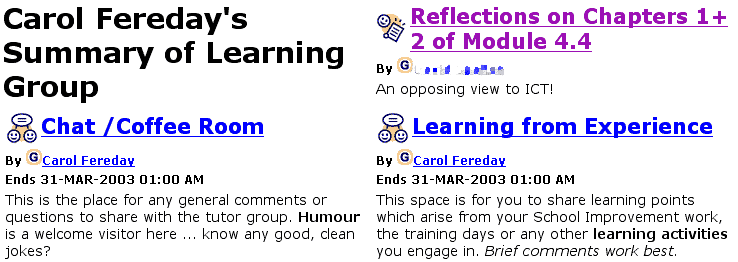
Image 5.2 A tutor's customized summary of
learning group space
Participants
have been keen to extend the remit of these areas initiating all sorts of
discussions including those surrounding the modules but at the expense of
participation in the Module Discussion Groups.
Virtual
Heads Module Discussion Areas were designed so that discussion could take
place with a large number of online learners. Discussions in these areas surrounded
the programme modules, which were regionally based and managed and were cross
phased. These communities aimed to provide online teacher-led, predetermined
discussions that were heavily focused on the specified activities within the
units. It is in this forum that online
learners were expected to share their pragmatic, school based experiences
and online teachers were expected to enhance those experiences by drawing
the online learners into a more reflective mode. Despite an increase in the
membership of these communities, from 54 in January 2001 to 300 in January
2002, there remains in May 2002 only patchy evidence of discussion in these
areas and a lack of clarity of purpose as the Shared Learning Spaces gradually
extend the discussions from the original brief into all aspects of the programme.
5.6
Key reasons for lack of participation in module discussion areas
A
number of reasons can be identified for the module discussion areas attracting
very few participants:
- Inappropriate
module questions. The NPQH module writing team had no experience or understanding
of working online when the questions to be discussed were written. These questions
do not lend themselves to online collaborative discourse.
-
Lack
of understanding of the new course philosophy on the part of online teachers.
'Self directed' was often seen as 'by yourself' in the eyes of the tutors.
- Pace
of the programme. The programme flexibility enabled online learners to work
through units in any order. This meant that very few of the learners would
be studying the same unit at the same time, thus the number prepared to discuss
an item was too small for discussions to obtain momentum.
-
Rhythm
of the programme. The expectation was that the programme would run as per
a face-to-face programme so that discussion items would be open for only
2 weeks. This rhythm was inappropriate for an online environment.
-
Lack
of purpose. Given the number of areas online learners were able to engage
in (DfES in Dialogue community, NCSL community, Virtual Heads, Summary of
Learning areas, Learning Journals, Learning Circles) the module discussion
areas lacked a strong enough purpose to engage learners.
-
Inactivity
by online teachers. Those new to the technology found it hard to overcome
the technological and structural barriers, this resulted in some regions
having no activities online for their learners.
Despite
lack of participation in these areas by November 2001 a number of online teachers
were experimenting with both the questions and the online environment by offering
less structured discussions, combining a number of questions and adding social
dimension to the communities. This stage is important as it marks the phase
when the online teachers became so confident with the technology that they
used their expertise as deliverers of learning to experiment in the environment.
However a real purpose for the Module Discussion Areas is still sought.
The Bursars have two communities,
the Bursar's Count community, to which all learners and tutors belong and
their Tutor Group which consists of about 10 learners and a tutor. The tutor
groups only have a noticeboard and a learning journal for each candidate.
It is in this forum that online learners are expected to share their pragmatic,
school based experiences and online teachers were expected to enhance those
experiences by drawing the online learners into a more reflective mode. The
tutors could use their time more effectively because they could see at a glance
who had recently contributed to their learning journal and therefore could
respond accordingly. Learners could see what the other members of their group
were learning and they were able to comment. They could also see how their
work was progressing compared with others in their group.
This smaller group is supported
by some face-to-face online tutorials and online learners are encouraged to
meet and visit each others schools. The online discussions here are focused
on the learning that each online learner has recorded. It was anticipated
that online learners will 'collect' comments, discussion points, questions
and answers from other parts of the online environment that are relevant and
key to their own learning and share these with their group. These form an
online learner's journal, which is shared and discussed online with their
tutor and which is the principle record of the formative learning.
5.7
Bursars' Development Programme - reasons for success
The
pilot for the Bursars' Development programme has yielded vibrant online spaces
from the outset. There are several reasons that may contribute to this success:
-
The programme has built on lessons
learnt during the first 3 cohorts of NPQH. For example the structure of
the Bursars programme has been refined and simplified to ensure success
with the number of communities being reduced.
-
Those responsible for running
the programme saw the developments in Virtual Heads and were therefore willing
to take advice from ULTRALAB facilitators so building on experience gained.
- ULTRALAB facilitators were involved
early in the programme developments and implementation so that the purpose
of online community was built into the programme and thus an integral part
rather than a bolt on.
-
Those running the programme are
committed to the online community, as evidenced by their interventions and
participation in the online community.
-
Participation in the online community
is assessed and is therefore regarded as essential. Philosophically this
gives the message that contributions are of value.
The important lesson from the
above account of the development of the structure of NPQH and Bursars is that
a clear purpose for each community is essential. The purpose needs to be expressed
so that online learners are clear as to the expectations of them in each area
created. In Cohort 1 of the NPQH learners were encouraged to set up Learning
Circles, but given the number of areas online learners were able to engage
in (DfES, NCSL, Virtual Heads, Summary of Learning, Learning Journals, Learning
Circles) this area lacked a strong enough purpose to engage learners. Similarly
the Module Discussion Areas are still in May 2002 seeking a clear purpose
which is not covered by other online spaces and which is strong enough to
engender discussion.
5.8 Integration of a programme
Most online programmes have some
element of stand alone programme materials. For the programme to demonstrate
value placed on participation and collaboration it is essential that the materials
do not stand in isolation. Value was demonstrated within the NPQH programme
by ensuring that access to the programme materials was via a hyperlink from
within the communities. This allowed online learners not only to use one ID
and password (that used to access the community software) but importantly,
emphasised the importance placed on the community and discussion elements
of the programme, because the online programme materials could only be accessed
by passing through the community space.
In addition the materials website
in NPQH enhanced the philosophy of participation and collaboration by continually
linking back to the communities and encouraging learners to comment. Image
5.3 below taken from the NPQH online materials site demonstrates this link.

Image 5.2 Signposting from the
materials website
The structure of the materials
site emphasised the reflective aspect of the programme as demonstrated by
image 5.4 below, taken from the NPQH Access materials site shows.
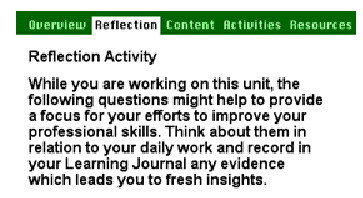
Image 5.3 Linking to the summary
of learning from the materials website
This continually reinforced the
programme philosophy. In terms of the diagram in section 1 (Table 1.1) this
meant that the NPQH programme firmly placed itself towards the constructivist
side of the continuum. In contrast the Bursars programme materials site was
developed as a self contained, divorced, structured task environment, sitting
firmly on the managed learning side of the continuum. The result of this was
that online learners, who were using the community for one month before the
materials site was developed were familiar and comfortable with participating
and sharing:
"Leaping ahead a bit,
I know that shall miss this community when the course is over and I know
from conversations at Dunchurch, that others will, too. I wonder if it might
be possible, for those who wish to, to stay on as members and perhaps contribute
and help with subsequent cohorts? It seems a good way of putting something
back whilst also consolidating our own learning. Do you think that might
be likely? :) "
"Not related to the course
at all really, but can anyone tell me what policies they have in place re:
risk assessment. This is something that we as a school need to look at and
I would very much appreciate any pointers. Thanks."
(Comments in
Bursars Count noticeboard)
These learners therefore found
the materials site disjointed and difficult. ULTRALAB emphasis that this was
not only a structural issue but more fundamentally a philosophical one.
As the move is made towards self
reflective, self paced study the pace of the course needs to be considered.
Within the NPQH programme online learners were expected to cover aspects of
the programme in whichever order and at whatever time they wished. As with
any truly flexible programme NPQH participants were able to make use of prior
knowledge and ignore those elements where their learning was sufficient if
they wished. This resulted in a programme where the online learners could
be studying any aspect of the programme at any time. Pacing a programme this
flexible was a challenge. In January 2001 the NPQH programme team had a vision,
taken largely from a face-to-face environment, of a two weekly cycle of activities
that participants could join in when and if they wished. This did not translate
well to the asynchronous online environment, where one of the main advantages
is the ability to slip time. Discussions closed before all online learners
had a chance to participate and those who chose to do the programme in a nonlinear
fashion found the areas they were interested in already discussed, summarised
and closed. In September 2001 the discussions surrounding the materials were
placed online at the start of the programme allowing online learners to add
discussion points when they liked. This however meant the discussions were
slow and disjointed, dialogue rarely developing and was one of the key elements
in the failure of the Module Discussion Areas (see sections 3 and 4) In the
more flexible Shared Learning Spaces aspects of the materials can be integrated
into the discussion when they affect the online learners to the rhythms and
demands of the school year can be integrated into the course, for example
the programme material on managing a budget can be discussed at the time when
the online learners are concerned with budgets in their school, with the online
teacher pointing to the archive of, or current 'live' expert discussion (hotseats)
on budgets. This enables a true integration of all elements of the programme.
5.9
Lessons learnt following 12 months of iterative development of NPQH
The
learners following the Access programme use the online areas more heavily.
This is because the emphasis in the Development programme is on school based
work, which means that participants have less need for online collaboration,
whereas in Access the emphasis is on sharing best practice and learning. This
emphasizes:
-
Purpose: there needs to be real
purpose for a community to flourish
- Size of community: as long as
there is strong purpose and a commitment to contribute a community can be
as small as 8 members and still be vibrant.
- Technological skills are easily
taught, good teaching skills are not. Strong and successful teachers in traditional
learning environments are able to transfer their skills online as long as
they are not technophobic. These people prove to be innovative and inventive
online teachers whose personality adds dimension to the online space.
-
The online environment is blunt
and exposing for weak teachers. Online teachers who do not deliver are obvious.
-
Participants, who are extending
their working day by participating in an online programme, only have time
to contribute to a number of spaces. Too many areas in which to contribute
lead to confusion and dilute the discussions.
-
Assessment for NPQH does not
formally include online elements, although a large number of online learners
agree that the programme is enhanced by online participation. As long as
participants are not formally rewarded for their participation contributing
online will be the first item to be dropped under pressure of work. Despite
all protestation to the contrary this conveys the philosophical message
that working online is of low value.
-
Those
working within online community need to be involved in all the early discussions
of any of the elements to lead to an integrated programme.
-
The
underlying course philosophy needs to be in symmetry with participation
and dialogue. It simply will not work to take a pre-existing programme and
add online community without fundamental changes.
-
Participation
in the online community should be part of the assessment process and be
regarded as essential. Philosophically this gives the message that contributions
are of value.
-
Programme materials must integrate with online dialogue.
-
There
is a need to ensure that the programme aims and objectives can be enhanced
by access to a learning community - that there is real purpose for each
community.
-
The
number of spaces for online contribution should be kept to the minimum.
-
The
pace and rhythm of the programme should be adapted for asynchronous online.
-
All
those involved in running online communities need to be committed to using
the online environment.
5.11
Facilitation of a programme
ULTRALAB have established in
their early work (www.ultralab.net/papers) that facilitation is essential
for any online community to thrive. Facilitation is a skilled activity and
those facilitating any online programme need to be aware of the aims, objectives
and philosophy of the online programme.
In the design of any programme
knowing who the target online learners are is essential. In January 2001 28%
of those applying for NPQH filled in the online application form, whereas
by September 2001 over 60% applied online. From this information the ULTRALAB
facilitators were able to anticipate that the level of access to the internet
and the higher level of ICT skills amongst the later intake would make the
online community aspects more successful. This, combined with the iterative
process which changed the programme (see section 4.4) resulted in the Second
cohort having a much more positive experience online. With the Bursars pilot
programme online learners were already using ICT in their work, (although
many had no experience of the internet) which meant, as anticipated, the technical
barriers were few. In addition for those participating in the Bursars programme
there was a degree of isolation from other colleagues being only one Bursar
per school. The community was effective in removing this isolation.
"Great idea to provide
current Bursar's Count members with some form of on-going support / links.
Everyone I'm sure finds the days together both socially enjoyable and professionally
rewarding. We all need to adopt a degree of continued professional development
after the Certificate and I think a Bursars Count "Old Boys" group
could be a very popular and supportive arena. Bursars Count has such a specific
momentum developing it would be a shame not to harness the NCSL's success."
(Comment in
Bursars Count noticeboard)
5.12
Reasons for success: dynamics of a group (bursars)
Hence
one of the key elements in success of an online programme is the dynamic of
the group the programme is designed for. In the case of bursars to following
factors combined to ensure that Bursars Count was successful and the community
valued:
-
Bursars are isolated and delighted
to have their voices heard.
- Isolation means that the participants
welcome the opportunity to discuss their work with other colleagues.
-
The lack of a recognised career
structure is an issue that is addressed by the programme. Participants therefore
approach the programme with enthusiasm.
-
Participants tend to be technologically
competent, their job ensures they use computers and email. They therefore
had less technological barriers to participation.
-
Although competent computer users
most participants had little experience of online communities or even online
user groups, so tended to be open minded towards innovative software which
does not follow traditional boundaries.
-
Online teachers are also technologically
competent so start with no technological barriers.
-
Less is expected of bursar online
teachers. Having learnt from the early failure of many NPQH online teachers
a simplified model has made the task of the online teachers in these programme
less onerous.
ULTRALAB's experience is that
at least two facilitators per programme are essential. Not only does this
allow facilitators to support each other and allows for exchange of good ideas,
but on a practical level ensures the community is covered over holiday periods
and that the communities are not left untended for more than 72 hours. Two
facilitators becomes especially useful when training of online teachers is
required.
It is essential that facilitators
are kept fully informed of programme developments, organisation and content
as well as the roles of others involved in the project. Within the development
of NPQH, ULTRALAB facilitators were not involved in, or given any information
about assessment process as this was seen as not in their domain. If, however,
they had been involved at an early stage they would have strongly advised
that some aspect of online community be involved in the assessment. Only after
three iterations of the programme is this now being 'written' into the assessment
process. In the example of the Bursar's programme those responsible for running
the programme saw the developments in NPQH and were therefore willing to take
advise from ULTRALAB facilitators thus building on experience gained.
5.13
Online teachers
ULTRALAB facilitators are experts
online, their expertise is in online facilitation and not in the subject of
the programmes. As such any programme requires online teachers. Online teachers;
make the online space welcoming and relevant to the programme participants
needs, ensure learning takes place through provocation/questioning/posing
of specific questions, direct the learning and the sharing of key learning
points, establish personal contact with programme participants if they encounter
difficulties or if they do not appear to be present a short period of time
after induction (for example 10 days) and allow online learners to display
their expertise online at the start - working online is hard enough without
having to engage initially in heavy academic discussion. ULTRALAB recommend
that starter discussion seek to draw on the online learners area of expertise,
making it easy to contribute but ensuring that all contributions are relevant.
One of the key roles of the online
teacher is the setting up of the online community space. Although the design
of the space will have been agreed before the programme starts ideally the
communities should be established by the online teachers so that they feel
'ownership' of the space. Online teachers should personalise the space, For
example they should have their pictures or icons published and write about
themselves if the software allows. This helps reduce the impersonality of
the online environment and a few sentences of introduction can help reduce
any reticence to communicate. It also encourages learners to do the same.
This is the online equivalent to wearing a name badge at a conference or programme
and encourages the building of relationships. There are a number of givens
in establishing the online community space outlined below;
5.14 Key recommendations
- The number of contributory items placed
online should be limited
- Make expectation clear in each online
space
- Ensure the space is welcoming and allow
participants to take some ownership. If the noticeboard becomes a 'meeting
place' then so be it. Be more creative about the use of tools so that essential
items are not missed.
- Online learners are more likely to engage
if observable activity has taken place and their online teacher is present
and obvious.
- The social needs of online learners
cannot be underestimated.
- Within discussion items make instructions
very clear and break them down into step-by-step tasks.
- Ensure deadlines are clear.
- Avoid links taking learners out of the
community. When it is desirable that they visit another web site then ensure
the link opens a new browser, thus encouraging them to return to the community.
- If learners do not make themselves 'visible'
then they should be contacted, preferably by telephone. They may be having
technical problems and be unsure or unwilling to ask for help. Learners
may never previously have found themselves in a situation where they cannot
cope and may not wish to expose their feelings of inadequacy.
- If an online teacher is to be absent
for any period of time they should make it clear to their learners that
this will be the case. A clear notice informing others of when they will
be 'off-line' is a matter of courtesy that is often forgotten.
With both the NPQH and Bursars
programme the online teachers had very limited experience working online.
In the case of NPQH 516 online teachers needed to understand the environment
in which they were to work in a very short period of time. NPQH online teachers
first saw the online environment in which the programme was to take place
in October 2000 when their usernames were created. The first cohort of online
learners were scheduled to come online and start the new programme in January
2001. This meant an intensive training programme was essential.
Philosophically ULTRALAB believe
in empowering people to take control of their own environment and do not believe
in a model of dependency. With these aims in mind the aim of any training
programme developed for online teachers is to empower them to run the programmes
and to allow for the disengagement from ULTRALAB facilitation.
Developing from ULTRALAB experiences
with both NPQH and Bursars training ULTRALAB believe that training for online
teachers new to working in an online environment should take place not only
face-to-face but in the online environment in which the programme is to take
place. An online training programme should ideally consist of;
1 day face-to-face training with
a full computer suite and a digital projector
4 weeks online training with
a commitment to contribute for 2 to 3 hours a week
The online training programme
should allow online teachers to experience being taught online, and thus through
skilled and active facilitation allow them to understand and model behaviour
for naive users. Thus the emphasis of any training programme should not be
on the technology but on the philosophy and understanding of teaching and
learning online. Commitment to participate is essential. A course modelled
on the guidelines above was developed for NPQH centre manages in September
2000, but with little commitment and interest on the part of some managers
participation was low. NPQH research has shown that in those regions where
the centre managers undertook the course and actively participated online
teachers have had less problems and thus the experience of learners has been
generally rewarding.
Online
teachers need an initial face-to-face induction programme followed by an online
extended course. The induction needs to clarify the course philosophy, not
simply concentrate on the ICT element. Although initially the overcoming barriers
to ICT may appear to be the strongest basis for training programmes, any training
based solely on this outcome will not lead to empowerment or arm online teachers
to work in the environment. For this reason it is essential that ULTRALAB
facilitators are involved in the programme developments so that training can
be integrated into the programme requirements and the programme philosophy
can be integrated into the training. Any training activities which do not
mirror the requirements of the programme and do not lead to understanding
and reflection on the use of the community environment will leave those being
trained unaware of the potential of the environment. In the early training
stages of NPQH not enough attention was paid to the change in the programme
structure and philosophy. Online teachers were not therefore left aware of
the full implications of a self-study, self-directed, flexible programme.
If the ULTRALAB facilitators had been involved in the whole programme, rather
than simply the online aspects, many issues could have been addressed at an
earlier stage and a number of problems could have been avoided.
After tutors had received their
initial NPQH training they were invited to join the Good Practice community
which was established in February 2001. This space was where the ULTRALAB
facilitators could communicate directly with all NPQH tutors, although support
via 'back channels' (email, telephone) is frequently sought. Advice on using
the tools and examples of a Module Discussion Area and Summary of Learning
Group were provided. Online teachers could ask the ULTRALAB facilitation team
questions, initially these were mainly technical but soon addressed other
issues such as participation.
"I need to set up some
easy way of flagging to all my tutor group that there is something they must
look at without sending stickies with detailed instructions to each."
(Sample comment
from online teacher in "Good Practice" community, 26th July 2001)
Since October 2001 it has started
to become a channel for online teachers to share good ideas and innovations.
This is a stage towards community ownership.
"At our recent tutor
meeting, our tutors wanted to know how we can evaluate what learning has gone
on from online activities. Has anyone any ideas?"
(Sample comment
from online teacher in "Good Practice" community 11th November 2001)
The online teachers on the Bursar
programme also had a community which was relatively small but used extensively
by organisers and online teachers for communication, dissemination of information
and sharing of ideas.
5.15 Online teacher training, summary
-
To clarify with online teachers
the process and procedures necessary to transfer face-to-face skills into
the online environment.
-
To share with online teachers
the philosophy of online community and the programme structure.
-
To share best practice in teaching
and learning online.
-
To empower online teachers to
run tutorial groups/communities.
-
To discuss innovation and experimentation
in the online environment across phases and/or regions.
-
To arm online teachers with the
technical skill to carry out programme requirements.
5.16
Online learners
As online learning is still new
many online learners will not have clear expectations from a programme delivered
largely online. This being the case an initial face-to-face element is useful
to set out expectations of all parties. In an environment which is self-study
and self paced, emphasising the knowledge residing in the participants expectations
could be set via a negotiated 'learning contract' between parties, but the
nature of such a contract will depend on the philosophy, cost and length of
the course.
As with any participative programme
there should be a clear code of conduct that generates appropriate expectations
for participation and reciprocity. This should be understood and agreed by
programme leaders, online teachers and learners.
Materials should integrate all
aspects of the programme, although for naive participants an ICT handbook
may be necessary. As the use of online programmes spreads this will cease
to be necessary.
It is vital that the holistic
nature of the course should be stressed to online learners and not simply
the ICT element. Although ULTRALAB believes that learning should be delightful
it also needs to be meaningful. Thus, it is important to demonstrate that
community has added value and provide examples which stress sharing and developing
good practice.
Hands on experience is desirable
because ULTRALAB experience has demonstrated that a successful first login
is vital. Evaluation after the first cohort of NPQH learners recognised the
desirability of learners having logged into the learning environment as a
part of their induction process which helps to 'debug' any initial problems.
With the Bursars programme this was not possible as online learners were given
only one hours demonstration of the system, but this was combined with a discussion
of the purpose and philosophy of the online learning community which is an
essential component of any demonstration.
Key recommendations
-
Expectations
for online learners should be clarified.
-
Purpose
and philosophy of the online community should be emphasized.
-
Participants
should be given an opportunity to log into the system whilst in the company
of their peers.
-
An
opportunity to take part in and visually experience a joint task/activity
is desirable.
-
Follow-up
online activities should be shown and available to complete at a later date.
heppell.net